
Here at eScholar, we believe that the education of our children is the primary engine that drives societal growth, innovation, and longevity. The health of that education ecosystem is one of the most crucial cogs in the technological advancement wheel within which we live in, and the intricate web of Artificial Intelligence investments, platforms, tooling, and infrastructure has now become the backbone of innovation in that space.
So who are the top investors in the AI + education world?
Microsoft comes in at the top of the list with the largest disclosed education focused commitment, with a whopping $4 billion investment via the global Microsoft Elevate Initiative. Microsoft also supports advanced AI credentialing and workforce readiness programs at a global scale alongside the American Federation of Teachers with its National Academy for AI Instruction announced in 2025. That $23 million education initiative, paired with their additional commitment to safety, privacy, and the overall protection of student learning in the classroom, the cognitive impact of leveraging AI, and practical training for educators, solidifies Microsoft as the #1 investor for AI education by a landslide.
Google is the next top investor with a $1 billion investment in education and workforce training commitment over the next 3 years. They have dedicated $150 million in grants supporting AI education/well-being and have developed the Gemini for Education generative AI assistant which is designed specifically for teaching, learning, and school operations. Moreover, Google has also invested a significant amount of resources and funding into the Chromebook program for students, Google Workspace for Education, and AI training programs for schools and universities. So, whereas Microsoft has committed to the larger, global approach to AI education best practices and safety guidelines, Google has cemented itself at the crux of tactical implementation and tooling across K-12 and post-secondary education.
Anthropic, on the other hand, has leaned heavily into the AI literacy and Creator Collective, which was launched by Teach for All, as another global education initiative. Their approach is supported by the creation and implementation of the Anthropic Higher Education Advisory Board, AI Fluency courses, a $100 million investment into Claude Frontier Academy, and a $200 million/4 year partnership with the Gates Foundation, to name a few.
That rounds out the list of the top three investors, but where does that leave us as far as the AI ecosystem as a whole? How do you untangle the web of infrastructure, platforms, and the overarching ownership of investment that determines your trust as state agency administrators?
Current Global AI Infrastructure, A Closed Loop System?
Making Sense of Ecosystem
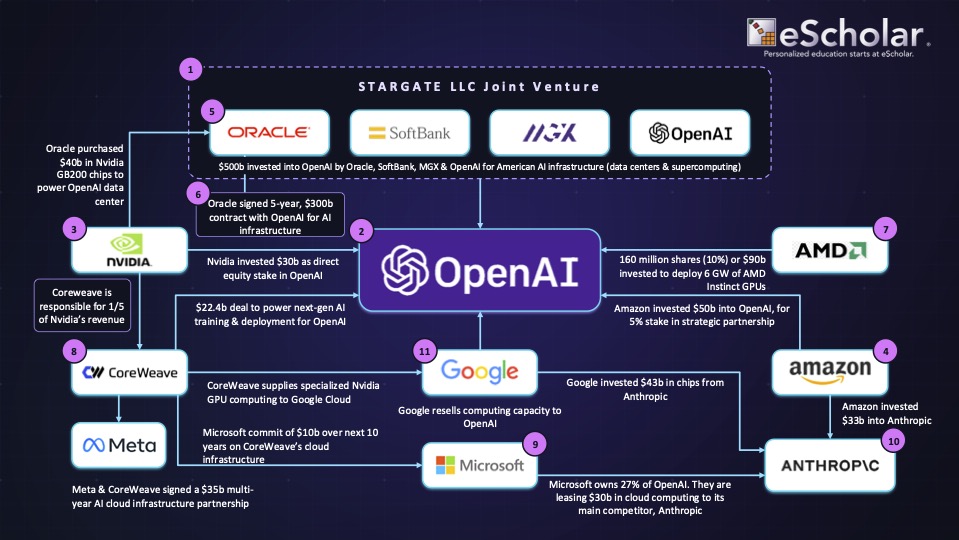
These 13 companies make up the largest, most impactful contributions to the technology, open-source models, AI research, and academic communities, but they are certainly not the only ones in the mix. But one of the first things you’ll notice in the hierarchy of ownership and investment partnerships shown above is that most are all funneling back to OpenAI. Even more, you’ll see that even the starkest of competitor delineations has not impeded the ecosystem’s ability to diversify and leverage the strengths of the other.
The Stargate LLC joint venture, for example, is the largest data center and supercomputing investment we uncovered in our research, with staggering $500 billion pledged (over 4 years) by Oracle, SoftBank, MGX, and OpenAI in 2025. Next on the list is Oracle, who made an independent $300 billion / 5 year contractual commitment with OpenAI for infrastructure. Then we have Nvidia, with a $30 billion direct equity stake in OpenAI, but is also backed by Oracle, who purchased $40 billion in GB200 chips to power OpenAI data centers in the coming years. CoreWeave, who supplies specialized Nvidia GPU computing technology, is responsible for 1/5 of Nvidia’s total net revenue, but is also connected to Meta, Google, and OpenAI directly.
Microsoft owns 27% of OpenAI, and although they are a direct competitor of Anthropic, they have no issue leasing $30 billion in cloud computing to them.
It becomes hard to follow rather quickly, doesn’t it?
So although these oligarchical powerhouses have found a way to collaborate, invest, and put a stake in the ground in terms of perceived success with their own long-term partnerships, where does that leave state agency leaders looking to prioritize ethics, accuracy, consistency, and compliance in their decision-making process? Is this entire industry trending toward a monopoly? And if the backend / frontend of any given tool or technology on the market is essentially being funneled, managed, or owned by yet another entity – how do SEAs and LEAs determine trustworthiness? Who establishes the gold standard in privacy and protection of student data?
Human Leadership in ‘The Loop’
With all these questions still lingering very much unanswered in ether, eScholar intends to lean heavily into following the ongoing investment strategies of the biggest players, the leadership and decision-making of each of these companies (especially the top three in AI education), and continue following the organizations that prove themselves as the strongest in protecting student data and privacy.
What will your agency do?
Contact Form Home
"*" indicates required fields
Resources
https://blogs.microsoft.com/on-the-issues/2025/07/09/elevate/
https://blogs.microsoft.com/blog/2026/09/16/microsofts-commitment-for-ai-in-education/
https://edu.google.com/intl/ALL_us/workspace-for-education/editions/overview/
https://www.anthropic.com/news/anthropic-higher-education-initiatives
https://blog.google/products-and-platforms/products/education/ai-education-efforts/
https://blogs.microsoft.com/on-the-issues/2026/05/07/the-state-of-global-ai-diffusion-in-2026/